Read An Excerpt From “How Long Things Hold” by Ys Goldt
A WIP by Author and Artist Ys Goldt. Read more about Ys and her published projects here.
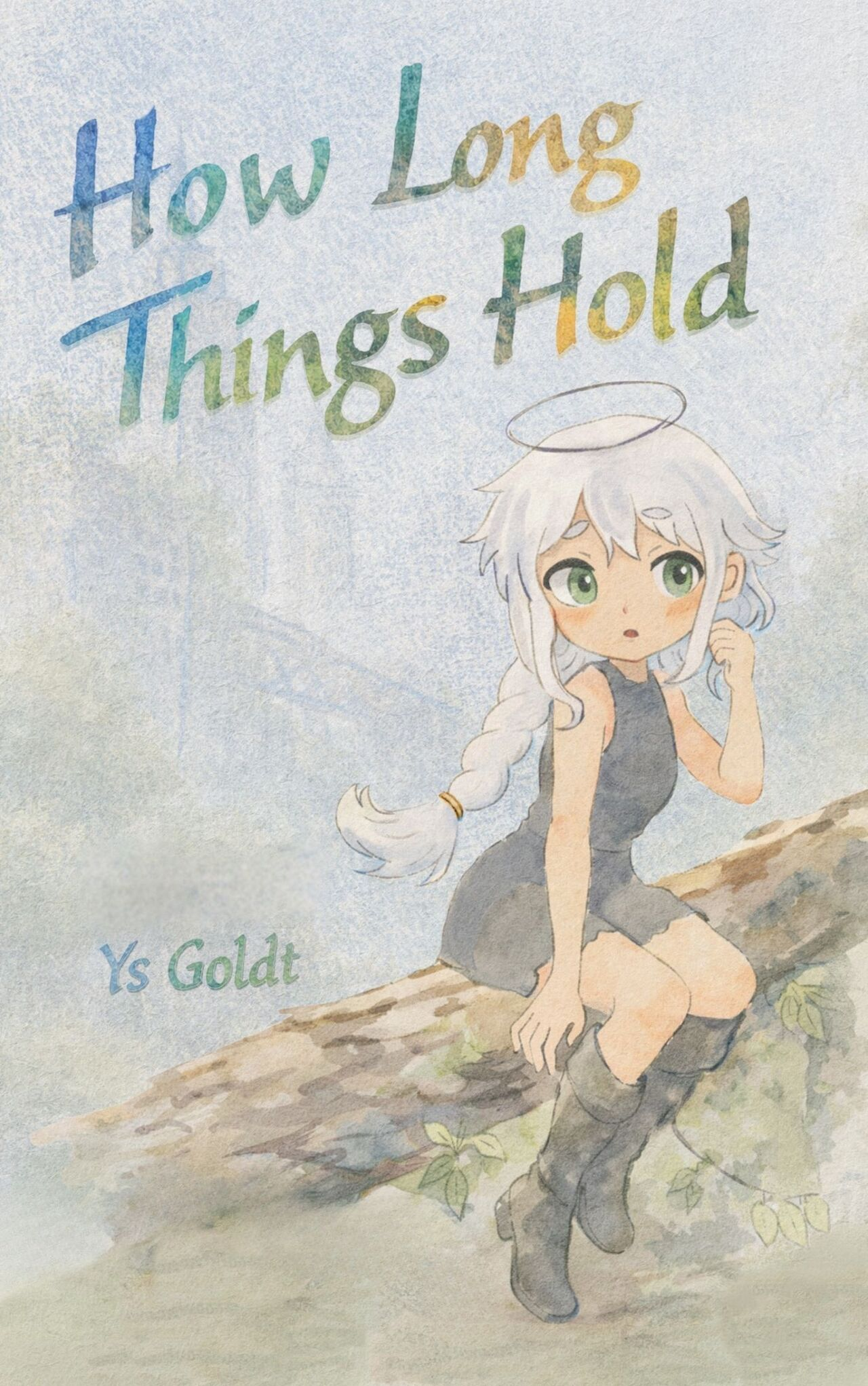
Eîra had been climbing the tree every morning for eleven hundred and seventy-five years. She would come out before dawn, when the air still held the cool weight of night, and make her way through the overgrown streets to the intersection. The tree was hers, or perhaps she was its. She knew which branches would hold her weight and which angle of her spine against the bark allowed her to sit for hours without shifting. Once, she had remained in the tree for fifty years. She could not recall why she had stayed, or why she had finally climbed down. The years blurred together when there was no one to mark them with; still, she could recall the first time she climbed the tree. The exact date, the temperature, the angle of light; Papa looking up at her from below. His voice came back to her memory, the words exactly as he had spoken them. Balance achieved on first attempt... Well done, my dear! This morning was no different. She found her branch, the one that extended over what had been a street, now split by root systems and volunteer saplings. Foliage screened her from below. She sat with her legs angled to either side, her hands resting on her thighs. She looked the way she always did, waiting for nothing in particular, or perhaps waiting for anything, any small change in the pattern of days that had stretched into centuries. She watched as the light shifted through the leaves, the way small creatures moved through the undergrowth. The street curved between collapsed structures, their facades had given way to ivy and the slow rot of centuries. Everything was the same as it had always been. Then, she heard footsteps. The sound was different from the usual; it was too measured, too intentional. Not the shuffle of decay or the wandering of animals. A figure entered from the northern approach, his footsteps deliberate on the uneven ground. He was tall and long-limbed, with a narrow frame through the shoulders and hips, and brown hair, somewhat unruly, fell around his face. His face showed little expression as he moved, only the slight tension of sustained attention. He paused three meters into the intersection and slowly turned his head to survey the buildings. His gaze tracked from the foundation to the roofline, then down again. Another Vasentia. Here. In her clearing. She had not seen another of her kind in five hundred years. There had been animals, of course, small mammals that moved through the ruins, and birds that nested in the collapsed structures. But no one who would look back at her, no one who would speak. He crouched beside a section of broken pavement, brushing dirt from the surface with the flat of his hand, then stood and moved forward again, stepping over a fallen street sign half-buried in leaf litter. The metal had corroded through in places, leaving only the bracket and a fragment of lettering. The wind shifted, stirring the upper branches. Eîra felt the limb sway slightly beneath her and instinctively adjusted her weight as a few leaves detached and spiralled down into the street. He stopped and looked at the ground where the leaves had landed, then up toward the canopy. His gaze moved methodically across the branches, tracking from the trunk to the outer limbs in a slow, deliberate scan. She tilted her head, watching him search, then, a small smile tugged at the corner of her mouth when his eyes found her. Her hair was ashen, almost white, pulled back in a long braid that rested against her shoulder. Above her head, a slender ring of dark metal hovered silently. She was small-framed, with a face that appeared young, though the stillness she held did not align with it and her large green eyes were fixed on him. Neither of them moved. He stood in the centre of the intersection, his head tilted back, looking up to where she sat high above him, framed by foliage and filtered light, one hand resting on the branch beside her. “Are you surveying this area as well?” His voice carried clearly despite the distance. What else would another Vasentia be doing here? he thought to himself. She blinked, then her smile widened slightly. “That’s quite informal… aren’t you supposed to say ‘Hallo’ first?” Her voice was lighter than his, more animated. “I’m Eîra. And I live here, so… I suppose my purpose is sitting in trees and watching surveyors walk through my clearing.” “I am conducting environmental documentation in this sector.” He paused. “I wasn’t aware anyone lived here. The settlement has no records of permanent residents in this area.” His gaze moved over her again, slower now. Her posture was relaxed, but not careless. He noticed a scabbard at her hip, wooden and worn smooth with age, with a faint suggestion of black metal within it. “You carry a sword?” “Big dogs wander through sometimes. They don’t bother me, but it makes me feel better if I have something to scare them off with,” she said airily. Eîra’s smile didn’t fade. She shifted her position on the branch, swinging one leg idly. “Anyhow, I didn’t think I needed to announce myself to you. I’ve been here a very long time, since before anyone was around to tell.” She crossed her arms, looking down at him. He adjusted his assessment. She is independent, isolated. “How long have you been here?” She put her finger to her chin, eyes closing briefly in thought. “About... eleven hundred and seventy-five years now? Give or take a season.” She opened her eyes and looked back down at him. “Since I was born.” Eleven hundred and seventy-five years? He had been cultivated four hundred and fifty years ago by another Vasentia. She predated the Departure by a century. She had been alone here, in this clearing, for longer than he had existed. Born… she speaks as if she were Dyn. As if the menhîrrum were a womb rather than an alchemical apparatus. He looked up at her. “Born,” he repeated. “Vasentia are not born. Birth implies reproduction and the transmission of random genetic inheritance. We are cultivated. Flesh and bone, yes, but alchemically grown within a menhîrrum according to intentional design. Your terminology is incorrect.” Eîra’s smile faded. “What do you mean by ‘cultivated’? I wasn’t grown! I was born… My Papa said so! Sure, it was in a menhîrrum but… still… Papa said I was born of his will… and… and… that’s all that matters!” She huffed, her arms crossing over her chest. She knew the proper terms; she had heard them before, long ago. But Papa had never used them. He had said born, and made, and his, and mine. Words that made her something other than just a construction of convenience. “Your creator, he told you to call him—” “Papa,” Eîra said firmly, her chin lifting slightly. “Not creator. Papa,” she said with slight annoyance. “He made me before the Dyn left. He said I was his memory.” Papa? It was a Dyn familial designation, one that carried relational weight beyond just function. Care, attachment, singular focus. He had seen the term used in the fragmentary pre-Departure records, and even then, it was considered quite anomalous for a Dyn to ask a Vasentia to use the term. “Papa,” he repeated quietly. “He made me because he loved me,” Eîra said, her voice softening. “And so someone would remember him, I suppose. After he went to sleep.” She paused. “That’s what he called it. Going to sleep. But he was Dyn, so…” She hesitated for a moment, looking up at the canopy, then back down at him. “So he died. Like the rest of them.” So she has been alone ever since? He opened his mouth as if to speak, then closed it again, looking down at his boots, then back up at her. “My name is Sâel. My function is survey and environmental documentation. I wasn’t aware anyone lived in this area.” Sâel. She repeated it in her mind, testing the shape of it. It suited him, precise and contained. “Well,” Eîra said, her earlier lightness returning, “Now you are.” He nodded slowly. “Yes. Now I am.” She watched him for a moment longer, then stood carefully on the branch, balancing without effort. “So then, are you going to keep surveying, or are you going to stand there processing all day?” “Ah— I will continue the survey route,” he said stiffly. “My documentation parameters remain active.” “Good,” Eîra said. She moved along the branch toward the trunk. “Because you’re standing on my favourite intersection, and I’d like to know what you’re writing down about it.” He looked down at his empty hands, then back up at her. “I do not write. I memorise. And the documentation is technical. Structural decay rates, biological reclamation patterns, material degra—” “Sounds boring!” She cut him off cheerfully, beginning to descend the tree. “But I’ll watch anyway.” Eîra had already decided she would follow him. Not because she was particularly interested in his work, but because the pattern of her days had changed the moment he noticed her, and she wanted to see where it would lead. Sâel looked towards the ruins. There was no protocol for this, no logged precedent for a resident requesting to observe survey operations. Establish distance parameters… Reassert operational independence, he told himself. He did neither. “You may observe… if it does not interfere with measurement accuracy,” he said. Eîra released her hold of the tree and dropped the last three meters, landing lightly on the broken pavement with barely a sound. She looked up at him, her head tilted back to meet his eyes. “I won’t interfere,” she said, still smiling. “I’m very good at watching.” He looked down at her. She was small and ancient; imprecise in her self-identification, yes, but certain in her presence. Something shifted in his côr, this was a variable he could not immediately name. He stood there looking down at her, then turned and walked toward the western street without another word. Behind him, her footsteps followed, light and unhurried.